



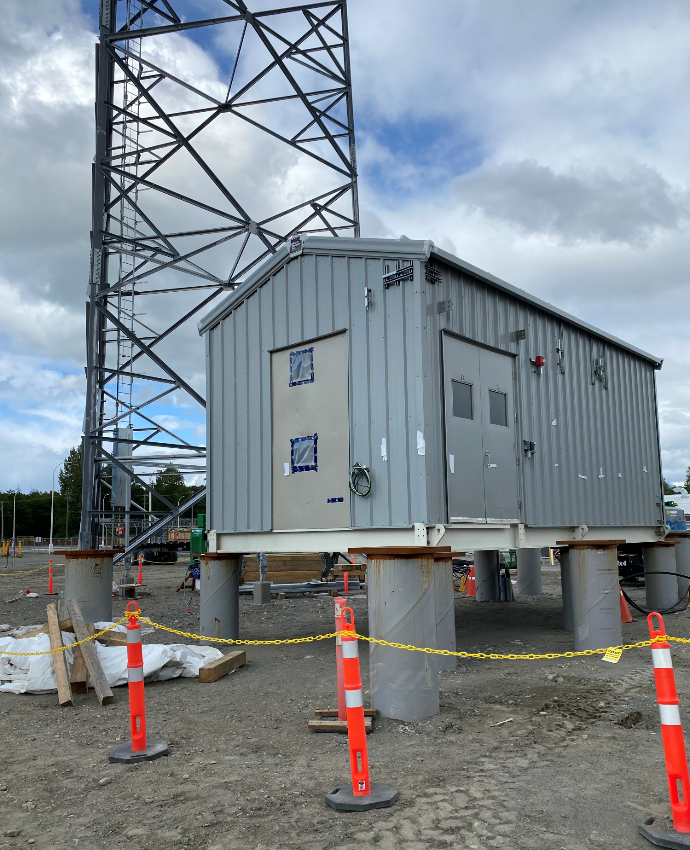

Telecom networks depend on secure, weatherproof enclosures to protect the switching, transmission, and backup power equipment that keep sites online — often in remote, exposed, or hard-to-access locations. Makloc’s skid mounted Self Frame buildings are purpose-built for this challenge: fully assembled off-site and delivered ready to set onto a pad, pile foundation, or tower compound, they minimize on-site labor, ground disturbance, and schedule risk. From single-rack equipment huts to larger multi-bay shelters, these structures give telecom operators a durable, code-compliant enclosure that can be deployed quickly across even the most remote parts of Western Canada.
All Makloc Self Frame buildings are certified CSA-A660, come complete with engineer stamped drawings, and are compliant with the National Building Code of Canada.
Applications
- Cell site & tower equipment shelters
- Small cell & DAS equipment enclosures
- Fiber & network transmission huts
- Edge data centre & network node enclosures
- Switching & control equipment buildings
- Battery & backup power enclosures
- Remote monitoring & communications compounds
Edge Data Centres & Network Infrastructure
As demand for cloud, AI, and low-latency connectivity grows across Alberta, more computing capacity is moving closer to the end user — into edge data centres and network nodes at tower sites, fiber routes, and remote compounds. Makloc’s skid mounted Self Frame buildings are well suited to these deployments: they can house server racks, network equipment, UPS and battery systems, and cooling equipment in a secure, insulated enclosure that is built and tested in our shop before it ever reaches site. The result is a faster, more predictable path to getting edge data center capacity online, with CSA-A660 certification and engineer stamped drawings included.
Why Skid Mounted?
Mounting the building on a structural steel skid means the entire shelter — walls, roof, and interior fit-out — can be built and tested in Makloc’s shop, then transported to site and offloaded by truck or set by crane onto piles. For telecom sites, where access can be limited and ground disturbance needs to stay minimal, this dramatically reduces on-site time and simplifies permitting compared to a site-built structure.